Author: Yuliia Puzanova
Can you imagine that your laptop or smartphone will participate in blockchain very soon? Yes, you, probably, observe recent years a lot of discussions about cryptocurrency, Bitcoin especially, the blockchain, mining and how different governments express their opinion regarding the legalization of mining, cryptocurrency, and blockchain overall.
The future of blockchain technology and the Bitcoin should be considered separately. The blockchain is promising technology which can be used in many spheres, while the future of Bitcoin is ambiguous. There are some skeptics who do not believe in a good future of Bitcoin. Especially, Cecilia Skingsley, the Swedish Central Bank Deputy Governor, expressed her point of view at World Economic Forum in Davos this year against Bitcoin as a currency and said that it can be possibly used only as an asset. One of the reasons for this statements is its high volatility (Figure 1). Moreover, The Nobel laureate economist Robert Shiller also said that he tends ‘to think of Bitcoin as an interesting experiment, it’s not a permanent feature of our lives’ and ‘we should broaden it out to blockchain, which will have other applications’ and emphasized several times that it seems to be the next bubble in financial system rather than a future for it. In this blog post, we will try to figure out the main aspects of blockchain technology and how different countries are preparing for this future.
Figure 1. Average USD market price across major Bitcoin exchanges

Data source: blockchain.info
The blockchain is not only about cryptocurrency. It is a transparent, credible, and immutable record of transactions. Put simply, it remembers all operations which were made with information contained in some storage. This data repository is not located just inside of one particular computer but is copied among millions of them. Blockchain technology provides the decentralized database which contains blocks with data and it is impossible to change it insensibly. Block can contain the following information: a vote, birth certificates, titles of ownership, money, contracts etc. Also, blockchain allows making a transaction without any intermediate party. For example, in a case of money transfer, we should include now the financial institution between sender and receiver of money, the third trusted party could be eliminated using blockchain, no need to rely on the governmental or financial institution to oversee the transaction or confirm the property rights. That is why blockchain is a very promising investment last 5 years and it continues to accumulate investments (Figure 2).
Figure 2. Blockchain annual global financing.
Equity funding (excl. initial coin offerings)
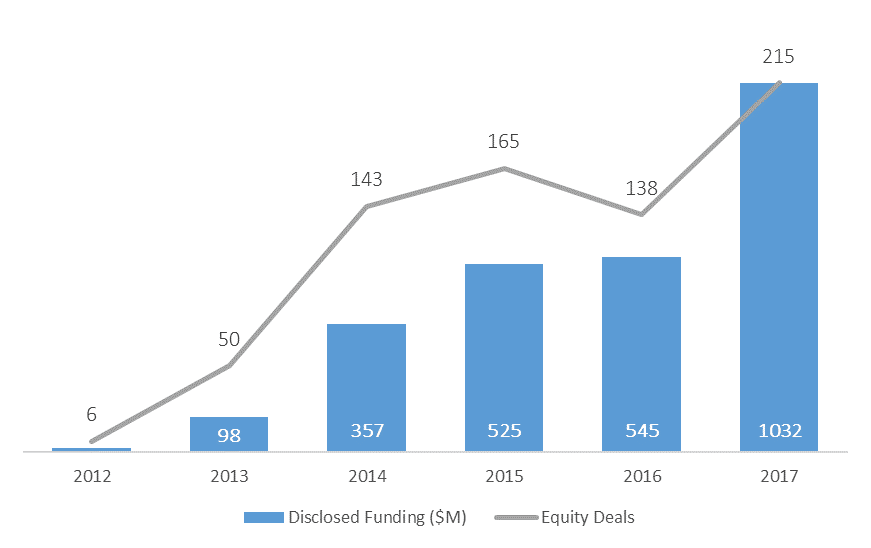
Data source: CBINSIGHTS
In WEF Report ‘Realizing the Potential of Blockchain’, Don Tapscott and Alex Tapscott wrote that ‘this second era will be powered by a clever combination of cryptography, mathematics, software engineering and behavioural economics’ and some governments are preparing actively for this new era and trying to implement technology in some of the possible directions: contract, asset or identity management, financial transaction management and even voting.
Estonia can be fairly claimed as a leading blockchain nation. Estonians data is decentralized and distributed ledger cannot be erased or changed as Kaspar Korjus, e-Residency Managing Director, stated in the blog post. But blockchain is not only used to make Estonians life clear and open. We also have to remember about economic benefits. In 2014, Estonia launched the e-Residency program. Its aim is to give a possibility to anyone receive a digital ID secured on blockchain to get an access to Estonian online services for registering a business, to manage it remotely, declare taxes and have an access for banking and international online payment services. As a result, 4272 companies from 143 countries1 were established in Estonia and brought to the country EUR 2.5 million (as at end of October 2017) total direct taxes, according to the analysis conducted by Deloitte2. By 2025 it is expected to reach nearly 1 million e-Residents and each company can bring to Estonia approximately EUR 70,000 of direct (state fees and taxes) and indirect (job creation, incremental demand, increased administrative efficiencies and country brand) net profit, as reported by Deloitte. Moreover, in prospect, each euro invested for the program development will bring 100 euro of the total return. Summary of the assumptions behind direct benefits and cost base conducted by Deloitte Estonia in 2017 is represented in Figure 3.
Figure 3. e-Residency financial analysis

Data source: 'Key Stakeholders’ Report. Estimated Economic Impact Analysis of the Estonian E-Residency Programme', Deloitte Estonia, 2017
Georgia also made a breakthrough using blockchain. In 2016, the country launched a project with The Bitfury Group and the Blockchain Trust Accelerator for registering the land titles in blockchain to eliminate the manipulation of the property registration data. Moreover, in 2017 a new agreement with Bitfury about the usage of blockchain technology to other government departments was announced. Marc Taverner of Bitfury said at the Legal Tech conference that new registration system helps to ‘have the whole process done in 10 minutes instead of three days’ and to reduce operational costs up to 90%. Furthermore, blockchain was applied for land registry in Ghana, Sweden, and Honduras.
Not only mentioned countries are testing new technology. China, Canada, the United Kingdom, Brazil, USA, and others are running pilot blockchain-based applications for government services (Figure 4).
Figure 4: Blockchain in the public sector (as of March 2017)

Source: Deloitte analysis in conjunction with the Fletcher School at Tufts University.
There are many of experts’ views regarding the future of blockchain. IBM Institute for Business Value and The Economist Intelligence Unit conducted a research on the basis of 200 surveys of government leaders in 16 countries and according to Executive Report 'Building trust in government. Exploring the potential of blockchains' 90% of surveyed government executives plan to invest in blockchain technology for applying in financial transactions, asset and contract management, regulatory compliance by 2018.
One thing is clear: we cannot count out the transformational influence of blockchain technology on economic development. However, the future impact of it is difficult to be evaluated due to not very long track record. Most of the projects presented now are as a trial or in a beta testing stage.
[1] https://e-resident.gov.ee/↩
[2] "Key Stakeholders’ Report. Estimated Economic Impact Analysis of the Estonian E-Residency Programme". Deloitte Estonia, December 2017 (provided by e-Residency)↩
[1] https://e-resident.gov.ee/↩
[2] "Key Stakeholders’ Report. Estimated Economic Impact Analysis of the Estonian E-Residency Programme". Deloitte Estonia, December 2017 (provided by e-Residency)↩


